Showing posts with label cuda. Show all posts

06 January 2017

Fluid.tox, move to GLSL


While I was visiting Russia last year, I was alerted to a thread on the TouchDesigner forums about some people who had found touchFluid on Github and were struggling to get it to work. Part of that had to do with me omitting some files from the public repo due to the licensing language on those files (which I was later told is out of date and will be revised), but they were also getting stuck on setting up their CUDA environment correctly. I don't blame them, Touch is only compatible with an older version of CUDA and is difficult to install on newer systems. You have to jump through a bunch of hoops to get an old version of VS which still isn't quite old enough so you still have to force CUDA to talk to it so you can build a dll. I couldn't work on it remotely anyway since my laptop is a Mac.

On a whim one morning, I tried transcribing my code to GLSL in Touch. It went surprisingly fast and I got it working in a couple hours. It was also about four times faster.

I made a tough call to drop supporting CUDA and move forward with GLSL. The main thing I lost was the potential to implement Ted's wavelet turbulence on the GPU. This was something I wanted to do as soon as I got Stam's stuff working, but the math and engineering involved was making it slow sailing for this Bachelors of Fine Arts noggin. With an installation deadline looming, I wasn't making progress on the art side fast enough either. Shader development time is faster, they're more portable, easier to read (more "hackable"), and are more performant given my circumstances.

CUDA is incredibly powerful and has the potential to completely maximize NVIDIA GPU's. The problem essentially came down to my desire to continue learning its nuances.

Writing kernels in CUDA is pretty easy, but writing fast kernels is a lot trickier. A common technique to speed up bandwidth is to use their concept of shared memory, which is essentially just a cache that performs 100x faster than reading from the GPU's global memory. It makes sense, but the code is ugly as sin and further obfuscates the already confusing thread/block/grid indexing scheme one is forced to use when working with thousands of cores. My code could have benefited from shared memory because many kernels use a Von-Neumann grid to look up neighboring values, causing about 4x redundant global memory reads. The problem was exacerbated by the fact that my data was stored linearly, so I needed huge strides to look up neighbors above and below the current cell- the image width * 4 (the rgba channels). According to this official blog post about shared memory, bandwidth drops by 80% after a stride of just 4 and continues to decline after that. This is the graph that convinced me to at least try shaders:
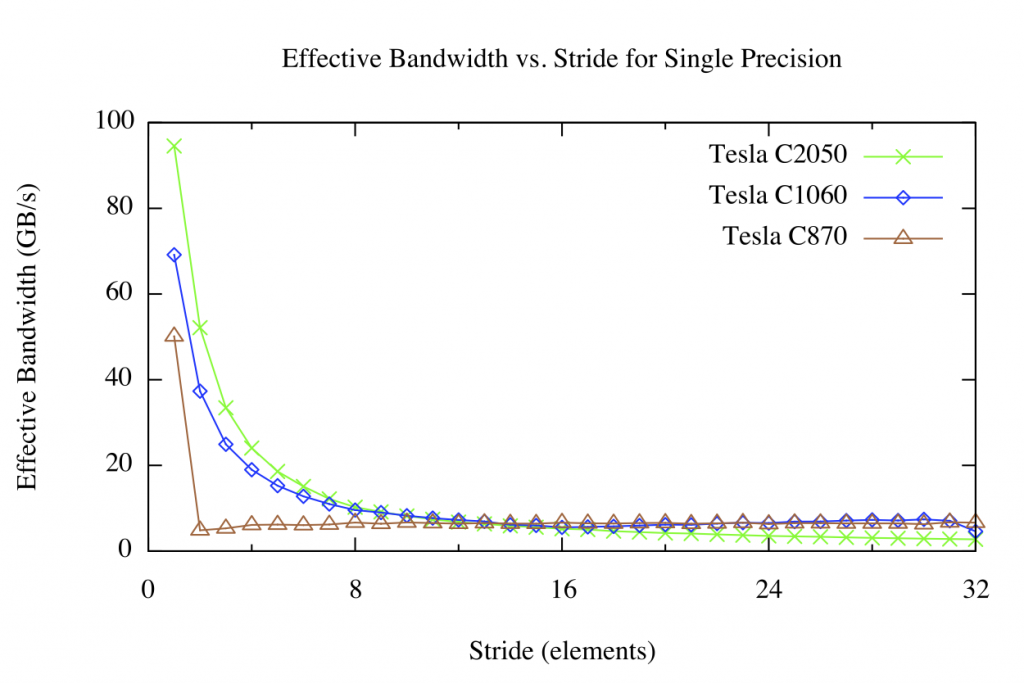


The speed boost I suspect comes from not having to deal with strides at all, instead encoding all the data into textures, which are optimized for random lookup.

Simulating using shaders is hardly a new thing. That, along with a few other oddities steered me away from them early on. You have to always be mindful that you are dealing with textures as a data structure so setting the filtering and format appropriately is crucial. They're also notoriously cryptic to debug, although that's slowly changing. Those are minor gripes when taking into account their ubiquity and accessible parallelism for visual media in general. The paradigm continues to advance with new hardware supporting things like dynamic tessellation and multiple camera matrices, and the community of users has never been stronger.

A couple months ago I wrapped everything up into a single tox, TouchDesigner's format for sharing snippets and single components, and put it on the forums to positive feedback. The CUDA repo lives on as a fork, but I'll continue working with the shader version from here on out.

24 April 2016

Particle trails


Messing around with feedback to get flow lines from the fluid sim. The color represents velocity direction and value is the magnitude of the velocity. Particles can bounce around obstacles and don't spawn inside them. 1 million particles @60 fps.

21 April 2016

GPU particles


Here's 250,000 particles being advected by the velocity field. This is being done using glsl shaders in TouchDesigner. The value of the particles is currently just the magnitude of the velocity, but I'll be adding a lot more color options later. I'm maintaining 60fps using a 512x512 fluid container.

I'm going to spend the next couple of weeks making big pushes in UI to prepare for a public demonstration at the end of year show. A lot to do still.

30 March 2016

Audio visualization, obstacle velocity


Here's a quick update that includes a couple new features: passing velocity in with obstacle data and rendering 3d geometry to a 2d image to use as input (although in this video, actual obstacles and density fields aren't present). I've got a simple particle simulation running on the CPU in TouchDesigner whose initial velocity and direction is being controlled by an audio waveform. I followed along with Derivative's 2016 Norway Workshop to get the system set up. Particle velocities are rendered as colors and piped into the CUDA sim. Adding these features went fairly smoothly.

Here it's very apparent that the simulation container doesn't have any interesting border conditions, which can be a good and bad thing. It's another feature to add. In the coming months, I'll be working on the UI, different composition techniques, experimenting with looks, and improving stability to prepare for MAT's End of Year Show. I've also become very interested in Ted's Wavelet Turbulence paper which would really send the visuals through the roof. No timeline on that yet, but it's going on the list.

16 March 2016

Boundaries and color


This update includes a lot of changes to the simulation algorithm as well as some new features. I ended up restructuring the velocity solve to mirror the one found in GPU Gems, which is still based on Stam's solution, but is more clear about the pressure and temperature fields, and simplifies the gradient subtraction a bit, so the performance is better.

For the reaction coupling, I diffuse two density fields with a laplacian kernel and apply the Gray-Scott equation, then advect them. Since there is a slight amount of diffusion from bilinear interpolation in the advection step, I suspect the Gray-Scott feed and kill values might be a little off. Nonetheless it appears stable. I'm passing a texture from Touch into cuda to define obstacles. The color is coming from the velocity, with hue mapped to its polar angle.

There are a lot of fields and variables to play with now. I'll have to decide if I want to start working on robustness and composition techniques, or to move forward with adding a particle system and pushing the resolution as far as possible.

25 February 2016

TouchDesigner + CUDA


I moved over to Windows and got reaction diffusion working in TouchDesigner using a CUDA .dll I adapted from my original experiments in Linux. This is a big checkpoint and hopefully represents the beginning of what will be the final environment and toolkit I will commit to for my thesis. Thinking of TouchDesigner as a modular OpenGL app authoring tool is extremely liberating.

I'm going to shoot for adding user-defined boundary conditions next as that seems to be coming up a lot lately. Color shouldn't be too far behind.

30 January 2016

particle advection


I got particle advection working with advection-reaction-diffusion and vorticity confinement. The particle system is based on Memo’s MSAFluid example. 100,000 particles being pushed around an advection-reaction-diffusion velocity field.

vorticity confinement


Here’s the previous advection-reaction-diffusion simulation with additional vorticity confinement and buoyancy terms. This gives me more control over the vortices and overall flow of the field. In the video I alternate the strength and direction of the buoyancy with mouse input. Coupled with reaction-diffusion, the grid fills up quickly, so I’m already thinking of intuitive ways to manage this without resetting everything. The implementation described here was a big help.

29 January 2016


I was working on visualizing the velocity field for simple advection when this Euclidean waterpark emerged.

advection-reaction-diffusion


Naive coupling of reaction-diffusion with Stam’s advection. The Gray-Scott reaction and simple 4 axis laplacian used for diffusion are not unconditionally stable as described by Kim, which I would like to make my next technical hurdle. I’m mostly excited about Ted’s anisotropic reaction-diffusion which has a lot of potential to be used expressively. 

I might take a step back at this point and start thinking more about the bigger picture in terms of application, artistic control, sound synthesis, and pushing the system visually.

25 January 2016

simple advection


This is a CUDA implementation of Jos Stam’s Stable Fluids. It is perhaps the simplest application of the Navier-Stokes equations and is focused on speed and stability over accuracy. Stam’s solution of back-tracing “particles” for the advection step is elegant and was fun to learn. I’m still trying to wrap my head around the projection term which forces the simulation to be energy conserving. Diffusion here is unconditionally stable using the Guass-Seidel relaxation he suggested in the games-oriented version of his paper.

cuda r-d


This was the first video I made while experimenting with CUDA. Here I was hoping to match to a simple reaction-diffusion program using FieldViewer. FieldViewer is a c++ application written by my advisor Ted Kim for his pattern formation class.

Since it was my first step into programming on the GPU that wasn’t using shaders, I wanted to verify the simulation results by comparing them to ones coming from the CPU in FieldViewer. I was able to match the diffusion term exactly, but adding reaction introduced a relative error that grew to 1e-4 after 10,000 frames. This is still an open question.

repo:
https://github.com/ultrareality/2_Graphics/tree/master/00_kk/simpleRD

Purpose

Every blog I’ve ever made has been abandoned. Generic, specific, referential, original, collaborative, private, it didn’t matter. I expect the same fate for this one, but this time I’ll welcome the end as it will, hopefully, be being in conjunction with my completion of the Media Arts & Technology program. This blog will be informal documentation of whatever I’m doing creatively up until that point, although the main focus is intended to be on my thesis. I hope to post about other projects I’m working on here as well, including research being done in the Allosphere.  The first few posts will be covering work done previously on my thesis, and I hope to eventually average at least one update a week.

A thesis in MAT can be more of a project and less of a publication, an option which I’ll be taking advantage of. I’m a little late deciding on something, but a topic is finally emerging involving dynamic systems, GPU/parallel processing, realtime rendering, and expressiveness. Ultimately I want to create an instrument in the musical sense that one plays intuitively. The output will be computer generated imagery and sound, although I’ve only focused on implementing visual systems and getting my feet wet with CUDA so far.

I’m giving myself a maximum of 16 more months to graduate which would mean I’ll get a Masters in a total of 3 years. Before coming here I had a head full of visual effects workflows and 3d software UIs which had to be abandoned to focus on programming languages, so I’m okay with that number. I’m okay with most numbers, though.